
A heartbeat through a wall, for twenty euros
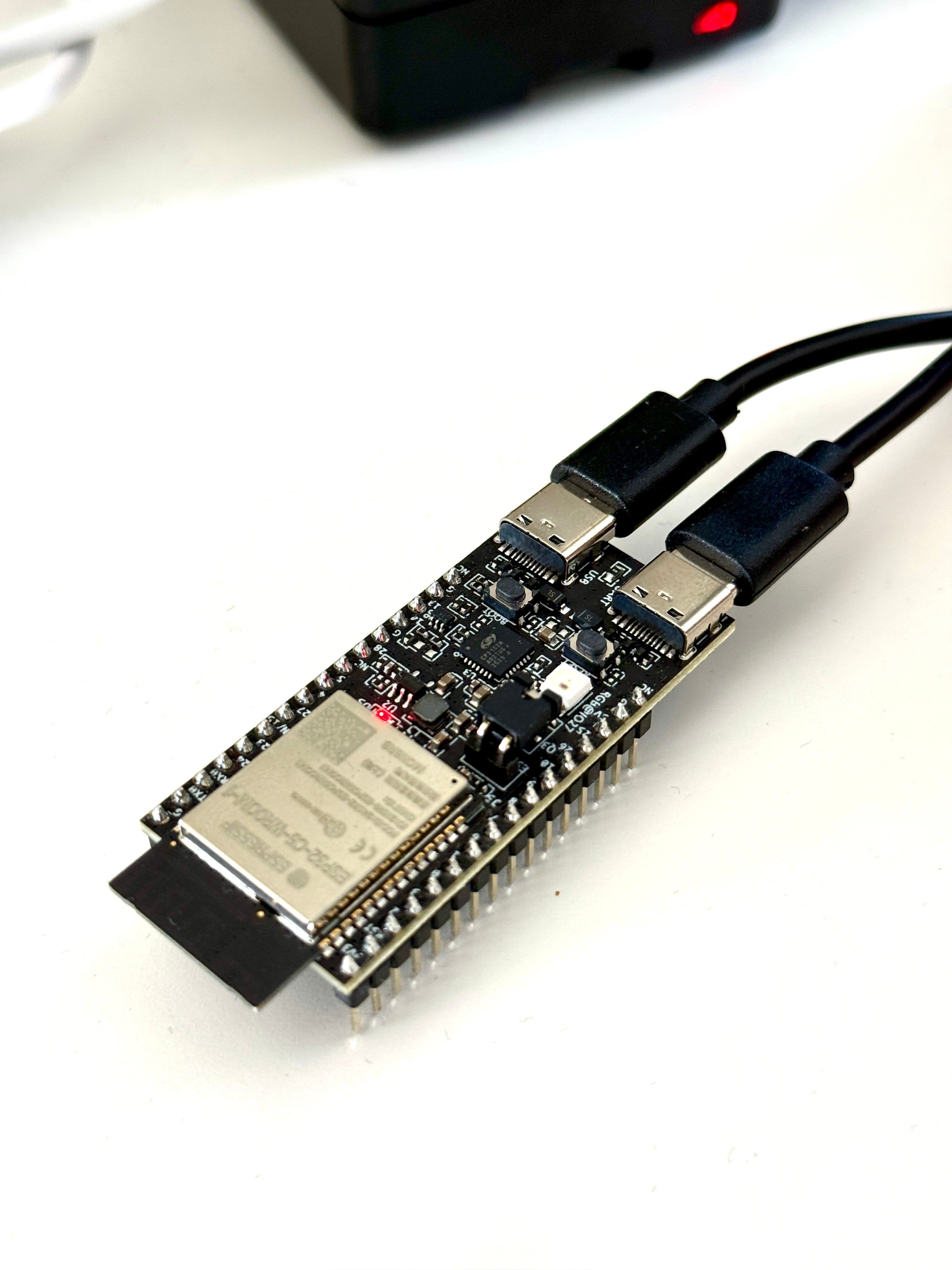
I built a working through-wall heartbeat detector for around twenty euros in parts, using two off-the-shelf ESP32 boards and an AI model to write the signal processing. It reads the heart rate of a person on the other side of a wall, with nothing worn or attached, from the way their body perturbs ordinary WiFi signals. The detector is part of an artwork I am working on. Nothing about the rig is exotic. The boards ship by the million into consumer electronics, and the technique has been documented in academic papers for over a decade.
I mention it first because the most common reaction to WiFi body sensing is that it sounds theoretical. It is not. The hard part is no longer the capability. It is that there is now a published standard formalising this capability into a commercial product category, a standard whose own working group was told that its sensing leaked heart rate, breathing, location, and identity to anyone listening, and shipped without resolving it.
This piece is about how that happened.
Two threats, not one
WiFi signals bounce off human bodies. Every WiFi receiver already measures these reflections, a quantity called Channel State Information, or CSI, in order to decode data reliably. Researchers have shown that the same CSI measurements can extract information about the bodies that produced the reflections: presence, movement, breathing rate, heart rate, gait, and under controlled conditions, even coarse body pose.
Two distinct threats are worth separating, because they call for different responses.
Passive CSI extraction works today, without any standard, on commodity WiFi hardware with modified firmware. A receiver analyses the CSI from normal ambient traffic. No cooperation from the transmitter is required, no special frames are exchanged, and the subject has no way to detect that sensing is happening. One precision I owe the technical reader: my twenty-euro rig is not quite this. Like almost every published demonstration, it uses a controlled link, one of my own boards transmitting on a fixed schedule, so what it proves is that the extraction itself is cheap, real, and runs on commodity chips. The transmit-nothing version, reading a network you do not control, is harder, and I have not demonstrated it. The reason to take it seriously anyway is that the standard’s own working group wrote it into its threat analysis, as we will see. I write from Europe, where calling it unregulated would miss what is actually wrong: covertly reading the heart rate and breathing of the person on the other side of the wall is almost certainly illegal under the GDPR, since vital signs followed over time reveal health status, the category of data the law protects most strictly, and a covert receiver has no lawful basis for collecting anything in the first place. What the passive threat escapes is not the law but enforcement. A receiver that transmits nothing leaves nothing to detect, nothing to prove, and nobody to name, and a person who cannot know they were read will never file the complaint. The protection exists on paper, and it stops at the wall.
Cooperative sensing, the kind the new standard is built around, is the deliberate version. In 2025 the organisation that sets the WiFi standard published an addition to it, named 802.11bf, that makes sensing an official feature: two devices that both support it take turns sending signals and reading how a body in the room disturbs them. It is sharper, and covers more space, than passive sniffing. But it has to be coordinated in the open, so it is at least visible and could be governed: the handshake between the two devices can be detected, and a device could be required to announce that it is sensing.
Hold onto the asymmetry, because it carries the whole argument. The more dangerous threat, passive extraction, is the invisible one, the one enforcement cannot touch. The more visible threat, standardised cooperative sensing, at least creates a framework that could be monitored. And as we will see, the committee was offered a protection that would have kept the standard’s own signals from feeding the dangerous case, at the layer where the leak lives.
The silicon is already shipping
802.11bf, published in full as IEEE Std 802.11bf-2025 on 26 September 2025, did not invent the capability. What the standard changes is not the physics. It is the commercial path.
The standard defines the protocol, specifies the frame exchanges, and tells chipset manufacturers how to implement sensing as a feature. Silicon vendors have begun building it in: Infineon’s AIROC ACW741x Wi-Fi 7 IoT family, announced in January 2026, explicitly advertises IEEE 802.11bf sensing via CSI, with development kits available, and Qualcomm’s Dragonwing platforms list Wi-Fi sensing via IEEE 802.11bf in their 2026 product briefs. Once this capability reaches consumer routers and mesh systems, WiFi sensing becomes a built-in feature that any software or service provider can activate.
This is why the timing matters. The window in which the chips have not yet shipped at volume is the window in which the rules can still be set cheaply, and it is closing.
The fix that was offered and never made
Here is the part that has gone almost entirely unreported, and it is more telling than the usual complaint that a standard “forgot” about privacy. The standard did not forget. The problem was raised, in the group’s own documents, and the group never agreed on what it was.
In July 2023, a working-group contribution (IEEE 802.11-23/0782) analysed the privacy of WiFi sensing and isolated what it called a threat unique to sensing: a passive eavesdropper, described as “any receiver within the coverage of the legitimate transmitter,” transmitting nothing itself, can perform channel estimation on the signals it overhears and extract, in the contribution’s own list, a person’s “locations, ... heart rate, respiratory rate, and even the identification.” The contribution rated the cost of mounting this attack as low and listed the countermeasure as “TBD,” to be determined.
Then a member proposed a countermeasure. During the formal review of the draft (Letter Ballot 272, comment resolution document IEEE 802.11-23/1109, comments 2226 through 2229), a participant proposed a secure transmission mechanism for the sensing signal, arguing that a sibling WiFi standard already protects its own measurement signals the same way. The comment, verbatim, noted that “11bf lacks protection for the sensing NDPs such as secure-LTF in 11az,” that “the user may expose privacy since the sensing signal may be eavesdropped,” and that “a secure transmission mechanism should be introduced in 11bf to protect user privacy.”
What happened next is more ambiguous than a vote against it, and the ambiguity is the real finding. The group discussed the analysis and did not converge. It would not grant that the threat was unique: on the body-eavesdropping issue the minutes record “disagreement,” on the grounds that “similar behaviour would ... be obtained using TWT” and a dispute “that beamforming is used in typical applications.” The fix would in any case have been partial, as I conceded about my own rig, since the dedicated sounding signals are not the only signal an eavesdropper can read. Yet a peer standards body had already treated this exact threat as a duty: the contribution itself recorded that 3GPP, in its Release 19 study, required that the 5G system “shall provide a mechanism to protect identifiable information that can be derived from the sensing measurements data from eavesdropping.” In the same discussion the group recorded a worry about the analysis itself: that “one must be more careful before publishing this kind of document as it may make WLAN sensing look very bad and especially if the concerns are not valid.” No agreed account of the problem emerged. The resolution document records it plainly: “the definition of sensing privacy is not clear and the group did not align on the characterization of privacy problem.” The proponent then withdrew his four comments, and, as the participant handling that batch, moved the routine motion to close them (Motion 389), which passed by unanimous consent, like dozens of other withdrawn comments that session. No one was struck down. The proponent stood down, the problem was left undefined, and the standard shipped in September 2025 with the body in the signal still unprotected.
The deferral defence is that the privacy work was simply handed off to a separate amendment, 802.11bi, which is being developed to improve privacy. That defence fails on a structural point. The passive eavesdropper never reads the data the devices exchange; it reads the raw radio signal itself, the waveform, and extracts the body from that. A fix therefore has to live in the waveform, which is exactly what the proposed protection asked for. The amendment the problem was handed to works somewhere else: by its own charter it modifies the rules devices follow when they talk to each other, things like hiding their addresses from trackers, and it cannot, by construction, change what the signal physically carries. The protection is homeless: out of scope where it was sent, and never defined where it belonged.
What the group did finish is the tell. When 802.11bf turns to security, it secures the sensing system, protecting the measurements from being spoofed or forged and hardening the apparatus rather than the person it reads. The protection it could agree on guarded the instrument; the one that would have guarded the sensed body was the one it could not agree even to define. The standard secured its own integrity and left the body in front of it exposed, not by oversight but by settling what the group could converge on and leaving open what it could not.
So the standard includes no privacy protection for non-participating individuals, no consent framework, no opt-out, and no mandatory disclosure. A person whose breathing pattern is being measured by a device in the same building has no protocol-level way to know it is happening.
The asymmetry that remains
Lay the two facts side by side. The threat that works today, on cheap hardware, invisibly, against anyone in range, is the one no standard touches and no regulator can catch in the act. And the standard that does formalise sensing into a product, the one place where a fix could have been written into the normative text before the silicon taped out, was handed that fix and let it lapse, with no agreed problem for it to solve.
The passive eavesdropper would never have set a disclosure flag or honoured a consent prompt anyway. What was on the table in 2023 was more fundamental: a protection built into the waveform itself, the kind the comment said a sibling standard already gives its own measurements. It would not have stopped my twenty-euro rig; nothing in this standard could, because ordinary WiFi has to stay readable to every receiver. It would have stopped the standard’s own sensing signals, dedicated sounding waveforms made to be measured, from becoming free raw material for the same attack. When the law cannot see the act, the only place a protection can live is in the signal itself. That is the protection that was offered for the sensed body, and never made.
These are not abstract harms waiting on some future capability. The capability is here, the chips are arriving, and the one structural chance to build refusal into the standard has passed. A follow-up piece will take up what should happen next: the consent gap between the regulatory frameworks that might apply, and the interventions that could still close it before the hardware ships at scale. For now the finding stands on its own. The invisible threat is the one the law cannot reach, and the protection that was offered for the sensed body went undefined and unmade by the very group that built the instrument.